Get Found by Nearby Customers with Local SEO for Small Business
Build a clearer local presence across search, business profiles, Maps and listings so nearby customers can discover your business and understand what you offer.
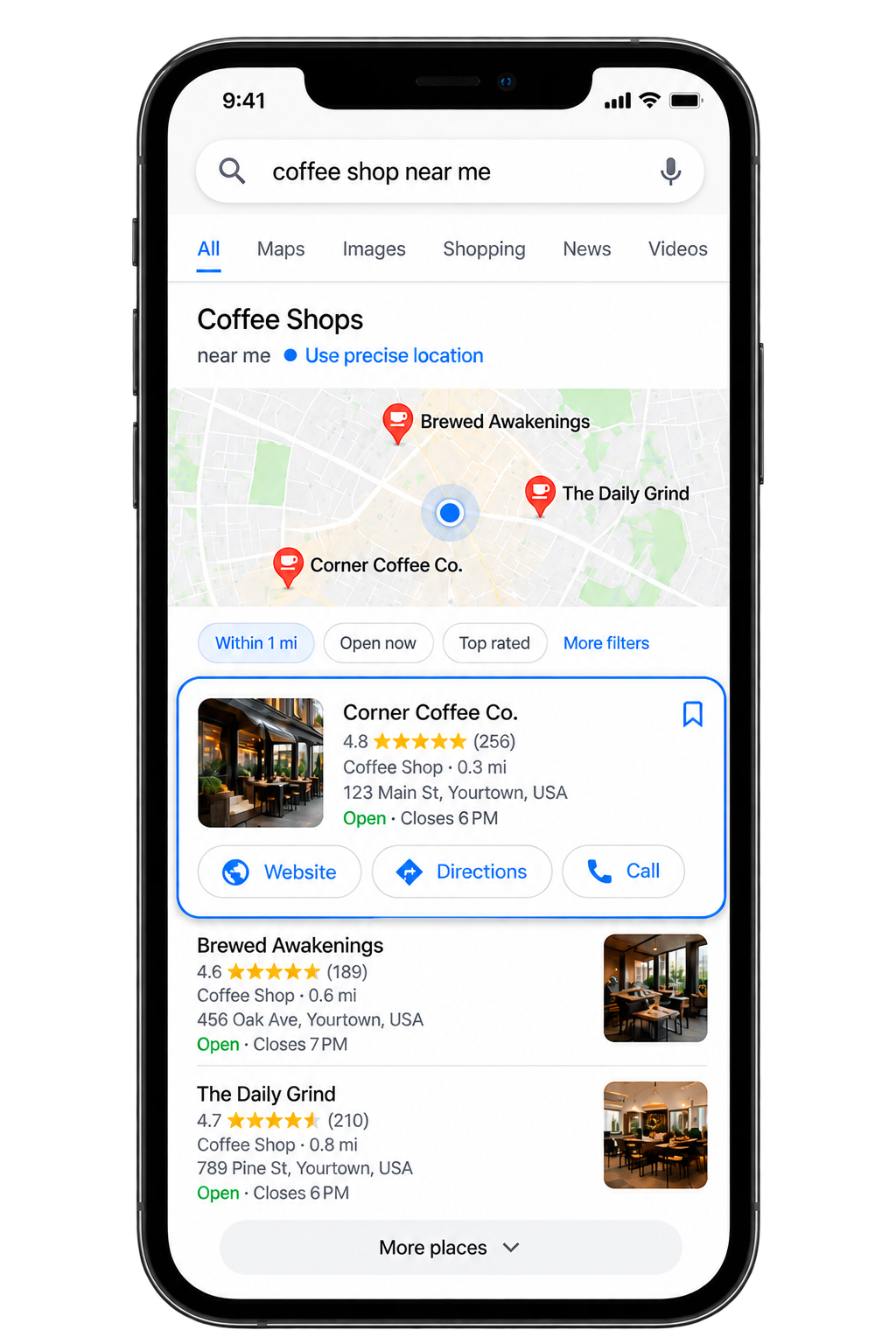
Get discovered locally •Reach local audiences • Build search presence
What Is Local SEO and Why Does It Matter for Small Businesses?
Local SEO (Local Search Engine Optimization) is the process of improving a business's visibility when people search for products, services, or businesses in a specific area. In simple terms, it helps local businesses become easier to discover when potential customers are looking for what they offer nearby.
This matters because search is already part of how many Indian consumers discover products and businesses. PwC reported that 50% of surveyed Indian consumers used a search engine before buying, while 12.5 crore consumers had started shopping online. These figures provide broader context around digital discovery rather than directly measuring local SEO. And with the rise of multiple services and goods being now available online it creates a sense of "need to have" a small online presence enough to get noticed and attract customers than rather opening shops and simply waiting for walk ins. Furthermore an online presence and discovery gives a chnace now for small business owners to actually compete with big businesses on an equal footing with tools available for everyone.
For a small business, local search optimization can help connect online discovery with actions such as visiting a store, making an enquiry or contacting the business which is the same flow used by big corporations as well.
Why Small Businesses Need Local Search Visibility
A customer often knows what they want before they know which business to choose. They may search for a product, service or business in their area and then compare the options they find.
This makes local search visibility important for businesses that serve a specific location. Simply having a website does not necessarily make it easy for a nearby customer to discover the business.
The broader digital landscape also shows how important online discovery has become. Meta and the Retailers Association of India reported that 77% of retail purchase decisions were influenced by social media. Businesses are having presence in places where it wasn't possible before and
For a small business, the challenge is therefore to make its business information, offerings and location clear enough to support local discovery.
Local SEO vs SEO: What Makes Local Search Different?
The difference between SEO and local SEO mainly comes down to the type of search visibility being targeted.
SEO generally focuses on improving a website's visibility for relevant searches, while local SEO focuses on searches connected to a particular location or local business.
For example, a business serving customers in a particular city may want to be discovered when someone searches for its products or services in that area. This requires more than simply optimizing a website for broad search terms.
Local SEO means making the business's relevance, offerings and location clearer for local discovery. Local search optimization can therefore include the website as well as the business's broader online presence.
The major difference only arises in getting found online and getting found online for a specific area.
Local SEO essentially builds on what an SEO does but pushes the end result from finding a website online to getting offline visitations.
How to Create a Local SEO Strategy
A practical local SEO strategy starts with understanding what customers search for and then making the business easier to discover for those searches. A few checks here can help formulate said strategy into something that fits in the stage of business today.
☐ Relevant local SEO keywords have been identified.
☐ Business information and location details are accurate and clear.
☐ Relevant Google Business Profile optimization has been completed.
☐ Important website pages support local search visibility.
☐ Local performance is reviewed regularly.
- 1. Identify local demand — Understand the products, services and locations relevant to the business.
- 2. Conduct local keyword research — Find useful local SEO keywords and understand how customers search for the business's offerings.
- 3. Optimize the business presence — Review important business information and carry out relevant Google Business Profile optimization.
- 4. Improve relevant pages — Make sure important website pages clearly communicate the business's products, services and locations.
- 5. Strengthen local visibility — Review the areas that can contribute to local search ranking and keep the online presence useful and consistent.
- 6. Monitor and improve — Review performance over time and update areas that need attention.
What Better Local Search Visibility Can Help a Small Business Achieve
The main purpose of local search visibility is to make a business easier for relevant local customers to discover.
This can be especially important for businesses whose customers are concentrated around a particular area. Better visibility can help put the business in front of people who are already searching for a relevant product or service.
A useful way to approach this is to focus on relevance rather than simply trying to appear for more searches. The business should be visible for searches that actually relate to what it offers and where it operates.
Businesses can also use relevant local SEO tools to research keywords, review visibility and monitor performance. A separate guide can cover the tools and their uses in greater detail. The most commonly used tool is Google Business Profile which gets all business information online for people to find. The other tool is using Google Maps the main place where their business is to be shown. Other tools include, Vyaparify which provide merchants to get their own website and catalogue setup with GMB Integration and many more.
Local SEO mistakes that weaken the customer journey
One common mistake is treating local SEO as simply adding a city or location name to website content. Effective local search optimization requires a broader view of the business's online presence.
Other issues include:
Forcing local SEO keywords into content where they do not fit naturally.
Creating pages that overlap heavily around the same search intent.
Making unsupported assumptions about local SEO ranking factors instead of reviewing the actual business context.
- Treating Maps as the whole strategy — google maps SEO may be valuable, but Maps is only one part of local discovery and further more just leaving your address won't do you any good it should be properly filled with proper landmarks and updated to ease customers finding you.
- Focusing exclusively on rankings — A local search ranking is useful only if the information a customer encounters afterward is also useful.
- Leaving outdated information online — Old contact, location or business details can create unnecessary friction and confusion for the customers.
- Optimising channels in isolation — A stronger approach connects discovery channels with the broader business presence instead of treating each one as unrelated. Go step by step and go ahead after fully optimising your information.
Building a Practical Local SEO Checklist
A local SEO checklist can help a small business turn local optimization into a repeatable process rather than a one-time activity.
At a basic level, review whether the business has:
Accurate business, service and location information
Relevant local SEO keywords identified through local keyword research
A properly reviewed Google Business Profile
Website pages that clearly communicate relevant services and locations
A process for monitoring local search ranking and local search visibility
The checklist does not need to become a long technical audit. Its purpose is to make sure the fundamental parts of the business's local presence are not being overlooked.
How Local SEO Can Apply to Different Small Businesses
Different businesses can approach local SEO differently depending on what they sell, where they operate and how customers search for them.
For example: a handyman service can instantly be found if searched "handyman service near me or near any are".
Emergencies with pharmacies can be resolved if customers know where to find one quickest to them.
Multiple businesses now have the opportunity to make people from all over the place that they exist and they are there to satisfy the wants and needs that they are now the alternative the consumer never had.
Frequently asked questions
What is local SEO for small businesses?
Local seo for small business focuses on improving how a business can be discovered and understood in relevant local search contexts.
What is local SEO?
Local SEO is the process of improving a business's visibility for relevant searches connected to a specific geographic area.
Is Google Maps part of local SEO?
Yes. Maps can be an important local discovery channel, but map-specific visibility is covered more deeply by the Google Maps Visibility Guide.
Why does business information matter?
Customers need accurate information to understand whether they have found the right business and how to interact with it.
Where should a small business start?
Begin with accurate information, review your main local discovery points, connect them to useful business destinations and maintain them over time.
Is Google Business Profile the same as local SEO?
No. Google Business Profile is one component of a broader local SEO strategy.
How to create a local SEO strategy?
Start with local demand and local keyword research, then optimize the business's online presence, relevant website pages and local discoverability while monitoring performance.
Turn local searches into meaningful business opportunities
Help nearby customers discover your business, understand what you offer and take the next step with confidence.